Materials
Poster
Official promotional image of the film
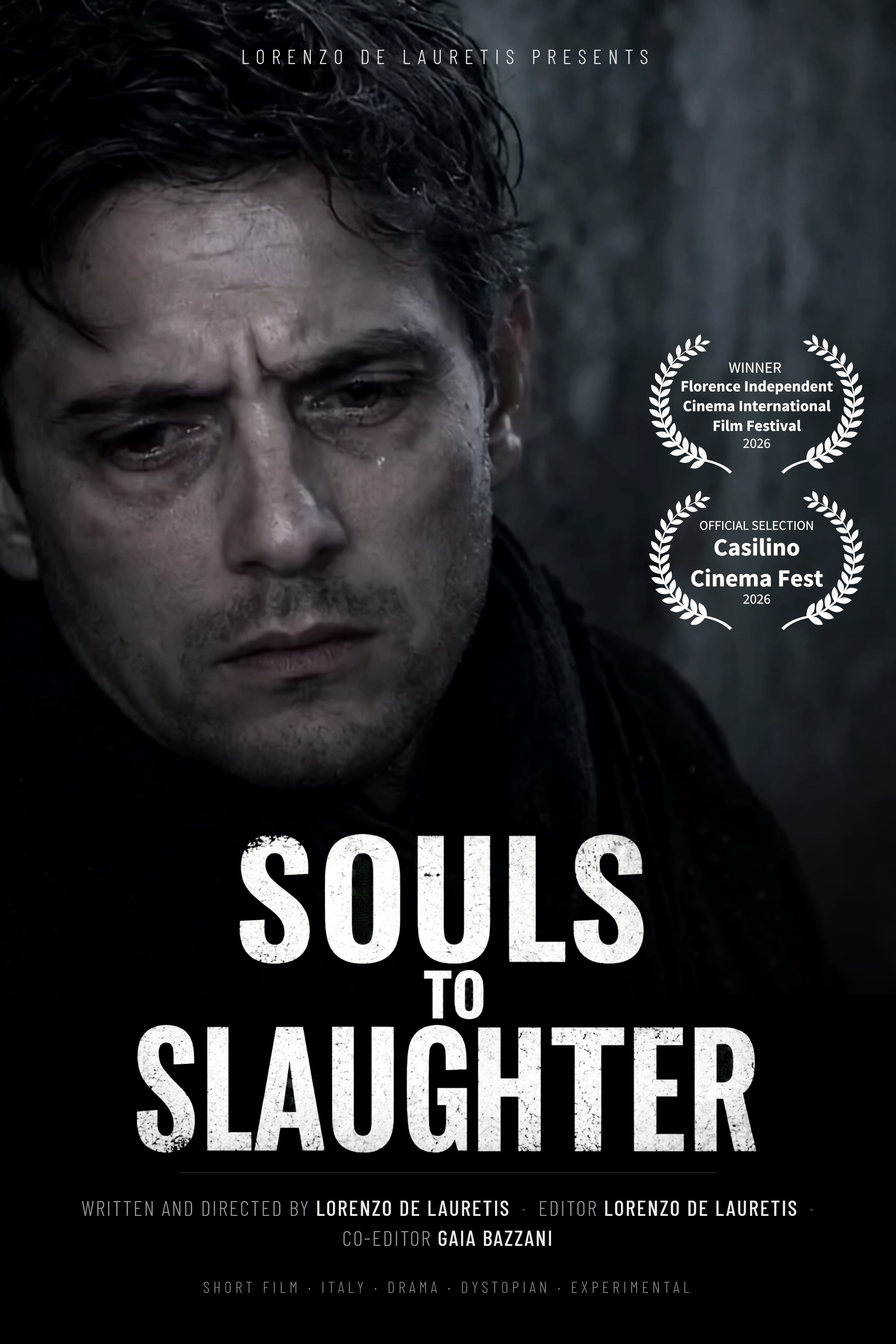
A film by Lorenzo De Lauretis
The Film
In a future where a virus has wiped out every animal species, humanity has found a way to survive, at a terrible price.
In a future where a virus has wiped out every animal species, humanity has found a way to survive, at a terrible price.
Gabriele tries to bring the truth to the world, only to discover that the most powerful enemy is not the system, but the indifference of those who choose not to know.
Truth has a taste no one should ever experience.
Souls to Slaughter — The Film
The most powerful enemy is not the system.
It is the indifference of those who choose not to know.
Official promotional image of the film
This film was produced entirely using generative artificial intelligence, integrated with traditional post-production pipelines. It is not the result of two clicks: it is the outcome of a long, technical and deeply human process.
Everything starts from the book. The screenplay was drawn from the novel Souls to Slaughter: dialogues extracted, scenes built, settings written page by page.
Conceptual artwork and character assets generated to establish visual identity, scene framing and aesthetic continuity across the entire film.
Motion synthesis and cinematic sequences generated with the open-source LTX Video 2.3 pipeline, maintaining prompt-level continuity and temporal coherence between shots.
Vocal timbres and dialogue built first with traditional digital audio synthesis, then processed and voiced with Cartesia.ai. Atmospheric score composed with Suno AI, with royalty-free textures from Pixabay.
All visual and audio layers assembled, edited, color-graded and mastered in DaVinci Resolve Studio. A heavy editing phase, as necessary as in any other production.
The film is ready. But behind every shot there is a work few imagine.
Base conceptual artwork and character assets generated via commercial API integration to establish visual identity and scene framing.
Open-source pipeline for motion synthesis and cinematic sequences, with prompt-level continuity and temporal coherence.
Vocal timbres and speech profiles first crafted with non-AI digital audio synthesis, then processed and voiced with Cartesia.ai (commercial tier) for nuanced vocal delivery.
Atmospheric soundtrack composed with Suno AI (commercial license), layered with royalty-free atmospheric textures sourced from Pixabay.
All visual and audio layers assembled, edited, color-graded and mastered within DaVinci Resolve Studio.
The common perception is that making a film with AI takes just two clicks. It does not.
Today, maintaining character consistency from scene to scene, matching dialogue to lip movement, keeping a stable visual identity for dozens of minutes, managing temporal continuity: these are open challenges, requiring continuous iteration, prompt engineering, discarded takes, regenerations and massive manual editing.
Generative AI is a powerful tool, but it does not replace the work of directing, editing, sound design. It transforms it, and makes it accessible to anyone with a story to tell. But the story, and the effort of telling it, remain human.
Questo film è disponibile anche in italiano come Anime da Macello. Visita il sito italiano per il trailer, la trama e la pagina IMDb.
Visita animedamacello.it/film →
Lorenzo De Lauretis is the author of the novel Souls to Slaughter and the director of its film adaptation, a dystopia that explores the boundaries of ethics, indifference, and silent complicity.
From the written page to the screen, he confronts the audience with an uncomfortable question: what are we willing not to see in order to preserve our comfort?